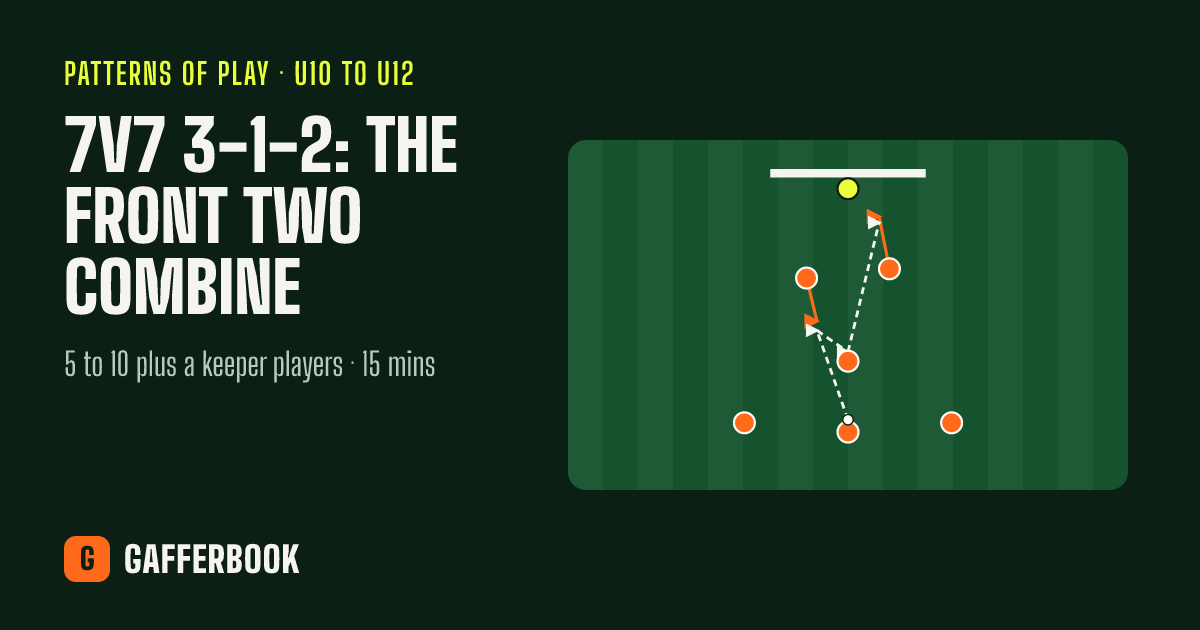
A 3-1-2 is strong at the back and up front, but has only one central midfielder, who is often marked. So the build-up can't rely on the midfielder alone. The back three find the free defender, one of the two strikers drops into the space between the lines, and the midfielder becomes the third player who receives facing forward.
Step 1 of 5
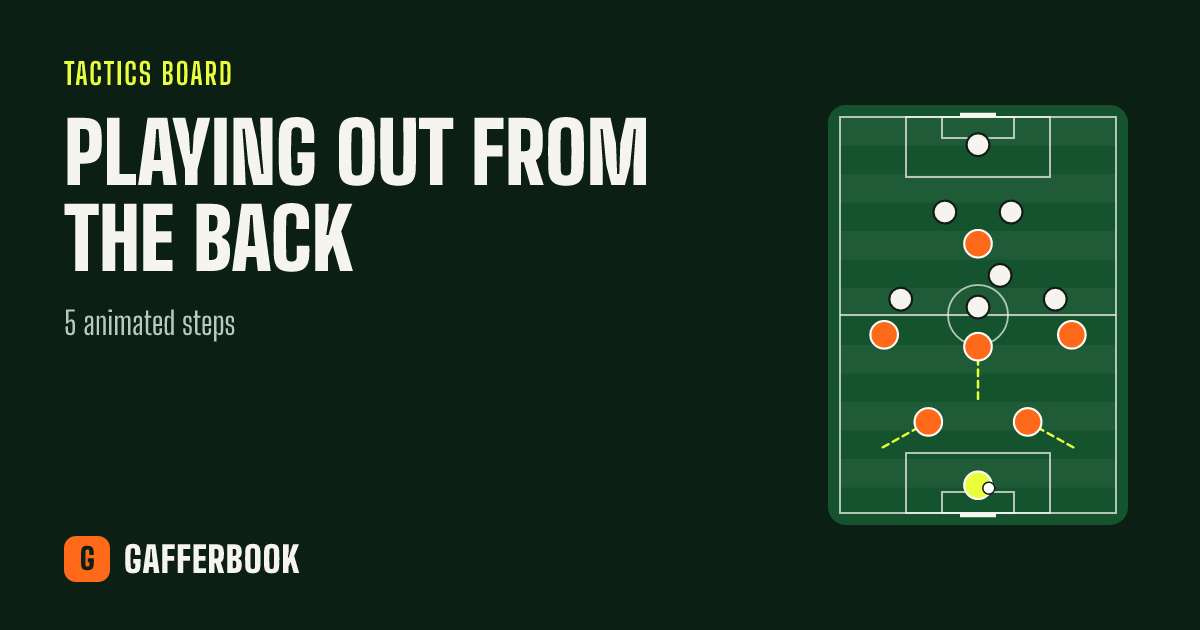
Goal kick. The back three spread, the midfielder shows, and the two strikers stay high and split.
Drawn for 7v7 3-1-2. Pick your own format and shape and every step is redrawn for your players. Then present it or send it to your team.
Step by step
Goal kick. The back three spread, the midfielder shows, and the two strikers stay high and split.
Keeper to the wide defender. Their midfielder sits on ours.
The right striker drops into the gap between their lines, pulling a defender with them.
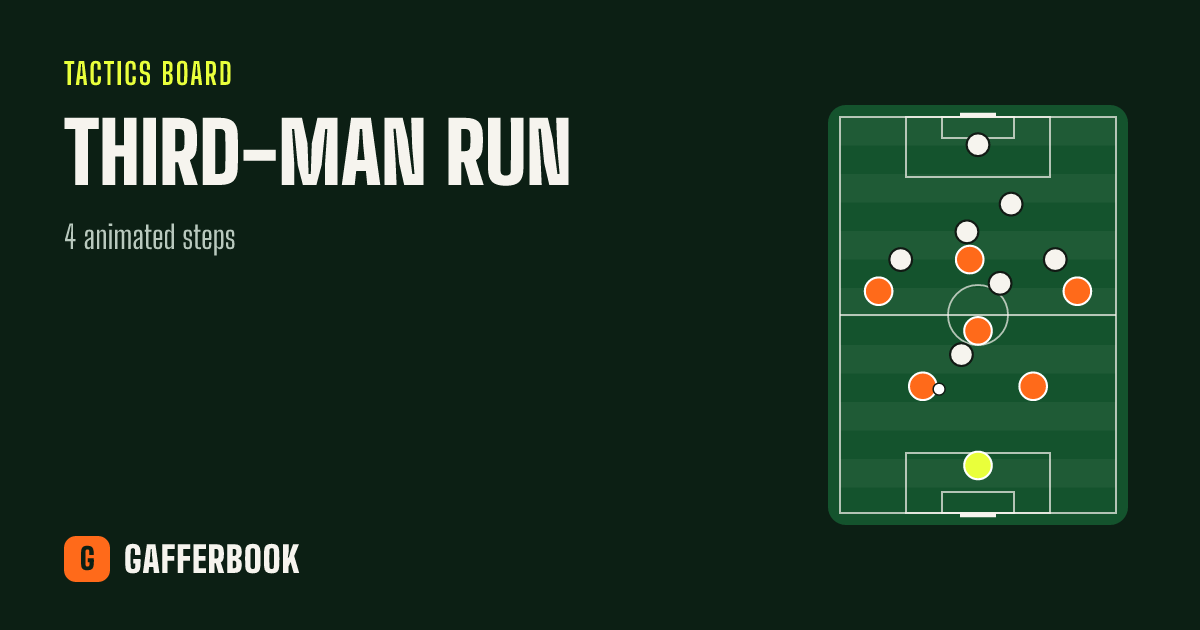
The defender plays into the striker, who sets it first time for our midfielder running forward.
Our midfielder turns and plays the other striker in behind.
When to use it
Against teams who press with one striker and mark your midfielder. It suits teams with two mobile strikers who like to come short.
Coaching points
The back three spread wide: with one striker pressing, one defender is always free.
The midfielder moves across to the ball side to make a short angle, even if marked.
One striker drops into the space beside the midfielder; the other stays high to pin the defence.
Play into the dropping striker, who sets it first time for the midfielder running forward.
The wide defenders carry the ball when nobody presses them. Don't pass for the sake of it.
With younger players
Use the retreat line for what it's for: time to practise. Mistakes will happen when playing out, and they're part of learning. Praise brave decisions, not just successful passes.
Who does what
Position
Their job
Back three
Spread wide, face forward, carry the ball when free.
Midfielder
The hinge. Moves to the ball side, receives the set and turns.
Dropping striker
Comes short between the lines, sets the ball first time.
High striker
Stays on the last defender to stop the back line pushing up.
Keeper
The spare player behind the back three.
When they change it
If they…
You…
Their midfielder man-marks ours
The striker drops into the space it leaves and receives facing forward.
Their defenders follow the dropping striker
The other striker runs in behind into the space left.
They press the back three with two players
Use the keeper to switch, and go down the side with the free defender.
Common mistakes
Both strikers dropping, so nobody is pinning the defence.
The midfielder hiding behind a marker instead of moving to make an angle.
Forcing the ball into the marked midfielder every time.
At 7v7, 9v9 and 11v11
7v7
The board: a 3-1-2 at 7v7. Two strikers give two ways to go forward.
9v9
At 9v9, a 3-3-2 has the same front two with more midfielders behind.
11v11
At 11v11, a 3-5-2 or 4-4-2 with two strikers uses the same 'one drops, one runs' idea.
It can be when defending. When playing out, the dropping striker becomes a second midfielder, which solves it.
Which striker should drop?
The one nearest the ball, or the one whose defender is less likely to follow. Agree it in training so they don't both go.
What if we keep losing the ball when we play out?
Expect it at first. Keep the shape, practise the same patterns in training under light pressure, and judge the decision rather than the result. If a game is getting away from you, it's fine to mix in a longer pass to the striker for a spell.